Everyone Says Demand for Intelligence Is Insatiable
Part One: AI Went to Software First Because Code Has a Judge

The short version
Everyone in this industry will tell you demand for AI is effectively unlimited. The chip designers say it, the hyperscalers say it, and the people building the model that wrote half your last email say it, at length, on podcasts.
All of these lovely people are probably right. But notice something about that list: every single person on it is long the answer. Not accusing anyone, it's just a sampling problem, and it's the reason this piece went looking for measurements and facts instead of opinions.
What we found was that apparently nine hundred million people a week use AI. But the number who use the agentic products that consume real quantities of tokens is not published by anybody -- the largest disclosed figure is 2 million, and a bottom-up estimate puts the true number in the millions to low tens of millions. Either way it is smaller by a factor of somewhere between fifty and five hundred, and it is overwhelmingly programmers -- among whom adoption is already at ninety percent and effectively finished. So the runway everyone is currently pricing is not a matter of adding users to the same curve; it requires this technology to cross into work where it has not yet demonstrably paid.
Furthermore, the best predictor of where AI crosses into next is not the service sector or professional label, it's whether the work has a judge -- some deterministic check, other than a human being, that can tell the machine doing it whether it was wrong. Just like code, which either verifies or does not. This single property, verifiability, and not the cleverness of programmers, is why AI easily tackled software first, and it points to a follow on destination very different from the call-centre story everyone tells.
Part 1: The bull case, stated at full strength
Three independent estimates hold that almost nobody is really using this technology yet -- and all three come from people with every reason to want that number to look small.
| Source | Estimate |
|---|---|
| Etched founders | "a few million paid users, 1/1000th of the global population" |
| Sundar Pichai, via Sacerdote | roughly 10 basis points of knowledge workers |
| Gavin Baker | 250,000 to 500,000 genuinely agentic users |
(Disclosure, per house rule: Sacerdote and Baker are investors, both long the sector; Pichai runs one of the companies in question.)
A low penetration figure is not a concession in this argument. It is the argument. One tenth of one percent penetrated implies a thousandfold runway; fifty percent implies the growth is nearly over. Etched pairs its estimate with a "multi-decade supply shortage" of tokens, Pichai pairs his with "we're already sold out," and Baker asks what happens "when we go from 500,000 to 100 million."
None of that makes them wrong. It makes them worth checking against what the companies themselves have published.
Part 2: "AI" is not one product, and the two biggest have little in common
Most arguments about AI demand proceed as though there were a single thing called AI that people either use or do not. There are at least two products here. They are bought by different people for different reasons, and they differ by roughly a factor of a thousand in what they consume.
| The assistant | The agent | |
|---|---|---|
| What it does | Answers one thing you asked | Runs a long, multi-step job you delegated |
| Who checks the work | You do, immediately | Nobody, until it finishes |
| Time per task | Seconds | Minutes to hours |
| Tokens per task | Hundreds to thousands | Hundreds of thousands, sometimes millions |
| What it costs the buyer | Rounding error, often free | Real money, metered, noticed |
| Who has it | ~900m people a week | no published total; the largest disclosed single product is 2m a week |
These are not two sizes of the same product. The assistant is a better search box: cheap, instant, and graded by a human the moment it answers. The agent is closer to hiring a contractor -- you describe an outcome, walk away, and come back to work you did not watch being done.
Nor do those two exhaust the category. There is AI inserted into products nobody chose it in, such as a search summary above the results; there are copilots embedded in software a company was already paying for; and there are agents that run for hours against a codebase. Each carries a different price, a different buyer, a different level of trust and a different token bill. Collapsing them is how "a billion people use AI" ends up in the same sentence as a datacentre budget, when the billion are overwhelmingly using the product that costs almost nothing to serve.
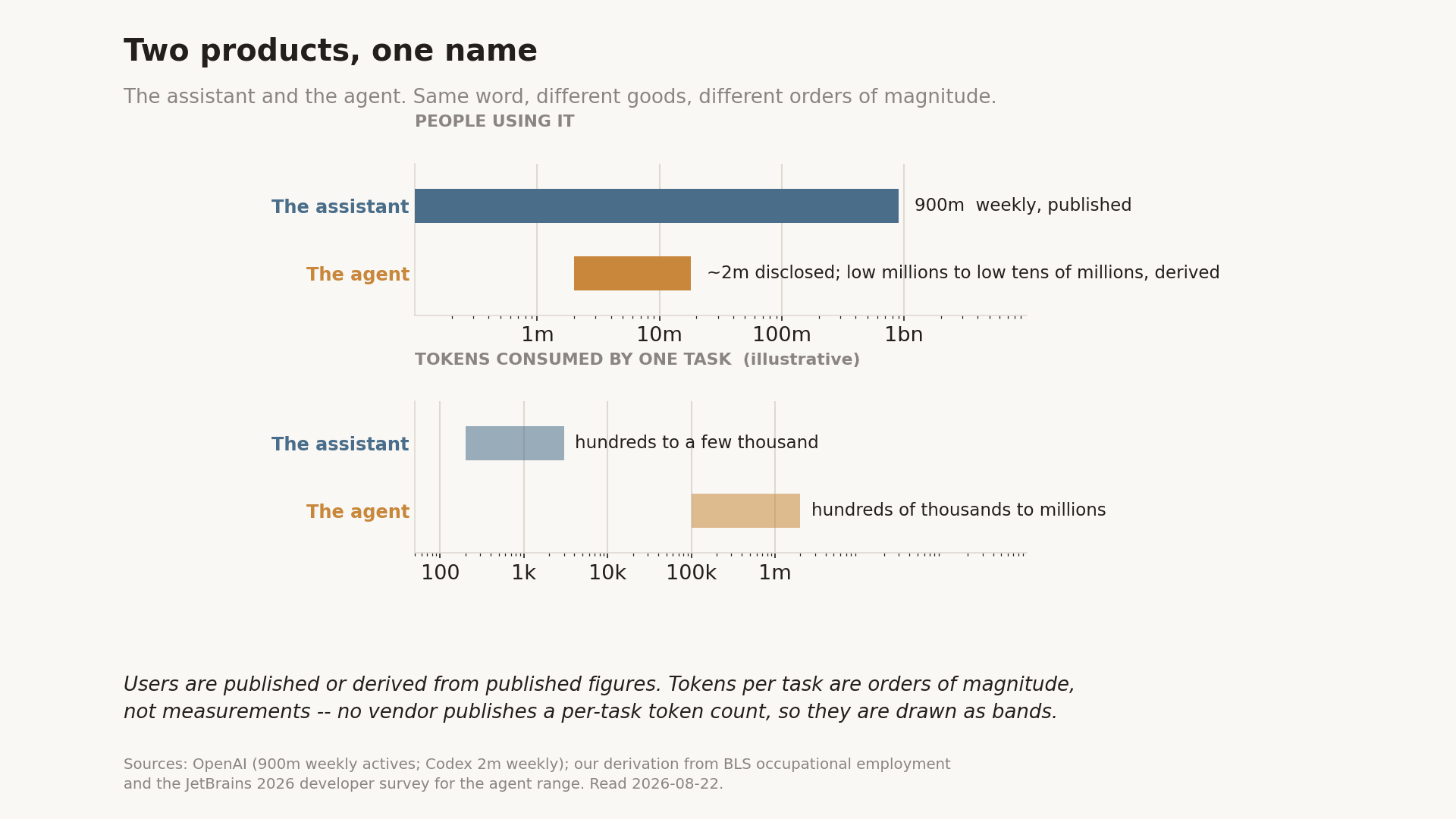
One row of that table carries the rest of this article: who checks the work. The assistant is graded by a human, instantly, every time. The agent is not graded by anyone until it finishes, which is why it can be trusted only where something other than a human can do the grading.
Part 3: Breadth is enormous, and nobody disputes it
| Vendor | What it publishes | Where it says it |
|---|---|---|
| OpenAI | 900m+ weekly active ChatGPT users; 50m+ paying subscribers | company announcement |
| 1bn+ monthly Gemini app users; AI Overviews reaching 2.5bn monthly | company blog | |
| Meta | no Meta AI user figure at all; reports 3.60bn Family Daily Active People instead | Q2 2026 earnings release |
| Microsoft | 30m+ paid Microsoft 365 Copilot seats | FY26 Q4 earnings release |
| Anthropic | no consolidated Claude user figure | -- |
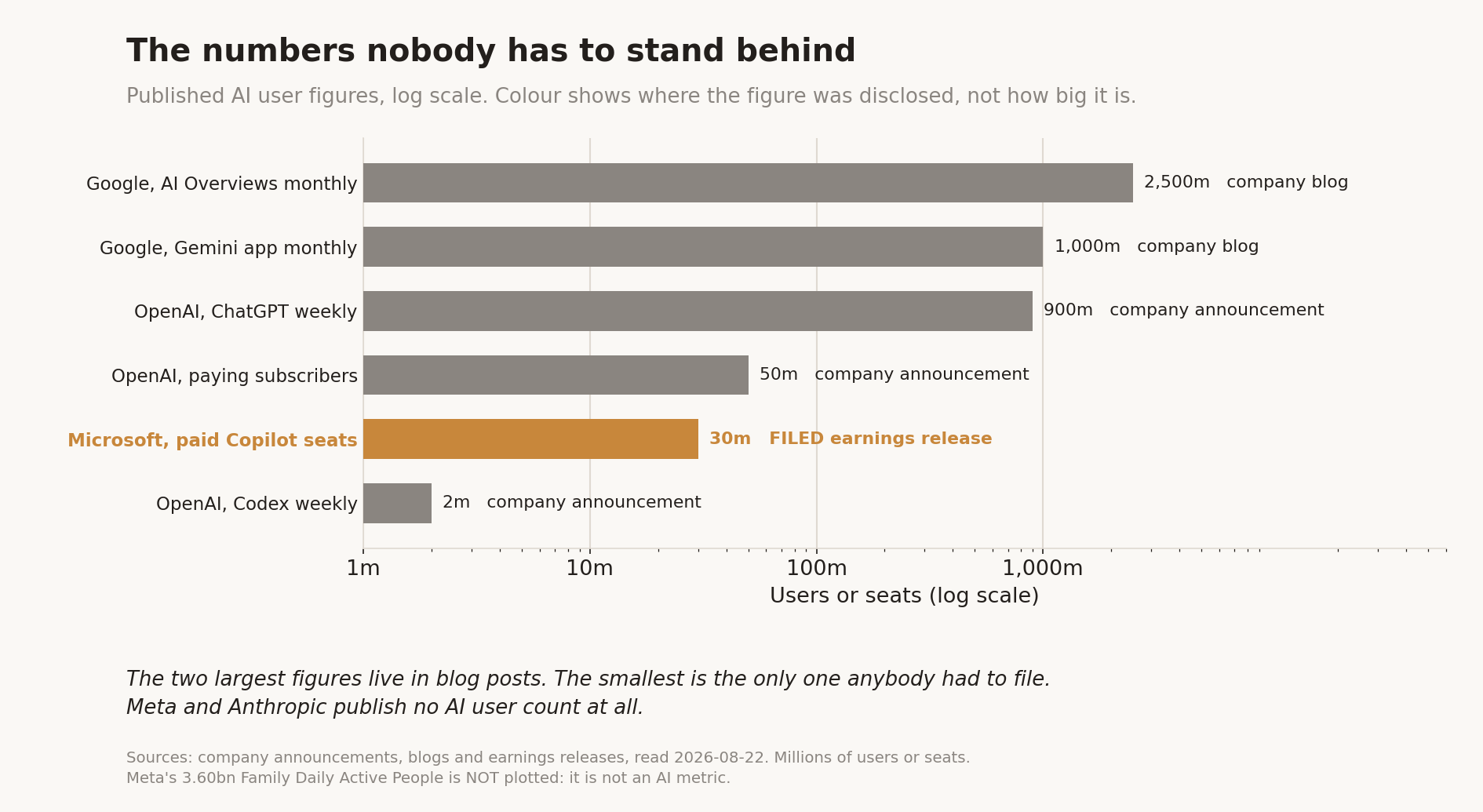
Nine hundred million people a week is not one tenth of one percent of anything. Whatever the penetration statistic describes, it is not the number of people who have touched this technology; on breadth, adoption looks closer to saturated than to early.
The table also says something the individual numbers do not. No two of these are the same measurement -- weekly actives, monthly actives, paying subscribers, paid seats, and, from two of the five largest AI companies in the world, nothing at all. They cannot be added, averaged or ranked. Each vendor publishes the metric that flatters it and stops when it stops flattering: Meta announced that Meta AI had passed a billion users when that was the story, and its latest earnings release does not mention Meta AI users at all.
The sizes run backwards to the scrutiny, too. The two enormous figures, 900 million and a billion, appear in company blog posts. The one that appears in a regulated earnings release, with legal liability attached to it, is Microsoft's 30 million paid seats -- three orders of magnitude smaller, and the only figure in the table that required somebody to have actually paid.
That is a point about arithmetic rather than honesty. The numbers large enough to justify the capital being spent are the ones nobody has to stand behind.
Part 4: Depth is a different number, and it lives almost entirely in one profession
The agentic products -- the ones that run long, multi-step, genuinely token-hungry jobs -- are where the published record thins out, and the thinning is itself informative.
| Vendor | Agentic product | What the company actually says |
|---|---|---|
| OpenAI | Codex | 2m weekly users, up 5x in three months |
| Microsoft | Microsoft 365 Copilot | 30m+ paid seats |
| Anthropic | Claude Code | $2.5bn run-rate, weekly users "doubled since January 1" -- no absolute user count published |
| Jules, Antigravity, Code Assist | nothing | |
| Cursor | -- | nothing company-confirmed |
How many people use an agent is genuinely unknown: no vendor publishes a category total, and two of them publish nothing at all. What exists is one hard count and two ways to sanity-check it.
The hard count is Codex, at 2 million weekly users. It is one product from one vendor, and treating it as the size of the category would repeat the error described in the previous section. A bottom-up estimate works better. If 90 percent of professional developers use coding agents at least weekly, then the 5.26 million Americans in computing and mathematical occupations imply roughly 4.7 million weekly agentic users in the United States alone, before counting a single developer anywhere else in the world.
A second check runs the other way. JetBrains puts Codex at 16 percent of professional developers and Claude Code at 39 percent. If 16 percent corresponds to Codex's 2 million, the implied professional-developer population is around 12.5 million, which would put Claude Code near 4.9 million. That figure mixes a survey share with a vendor count and should be treated as an order of magnitude rather than a measurement; Codex's 2 million may well include people who are not professional developers, which would pull the implied population down.
Both routes land in the same place: millions, plausibly low tens of millions, and certainly not 2 million. Gavin Baker's 250,000 to 500,000 sits below all of it because he means something stricter by "agentic" than "used a coding agent this week." The honest summary is a range with an unpublished middle, and the width of that range is the point: this is the number on which the entire capital expenditure cycle depends, and no company in a position to publish it does.
Google will tell you it has a billion Gemini users. It will not tell you how many people use Jules. Breadth gets a press release; depth gets silence, or a growth rate with no base under it. That asymmetry is itself evidence about which number the vendors think is impressive.
The sharpest figure does not come from a vendor at all. JetBrains surveys more than 15,000 professional developers a year, and in May to July 2026 it found:
"90% of professional developers were using AI coding agents at work at least weekly... with 68% using them daily."
That is saturation, not early adoption. Claude Code alone reached 39 percent of professional developers worldwide, up from 18 percent in January, and Codex went from 3 percent to 16 percent over the same period. Among the people this technology was built for, the land grab is largely finished.
Which is the difficulty with the bull case as it is usually told. The US Bureau of Labor Statistics counts 5.26 million Americans in computing and mathematical occupations against 63.9 million in knowledge work overall, making developers about 8 percent of knowledge workers. The honest position is therefore:
Agentic AI is at roughly 90% weekly adoption inside the 8% of knowledge work that is software development, and at far lower and much worse measured adoption across the other 92%.
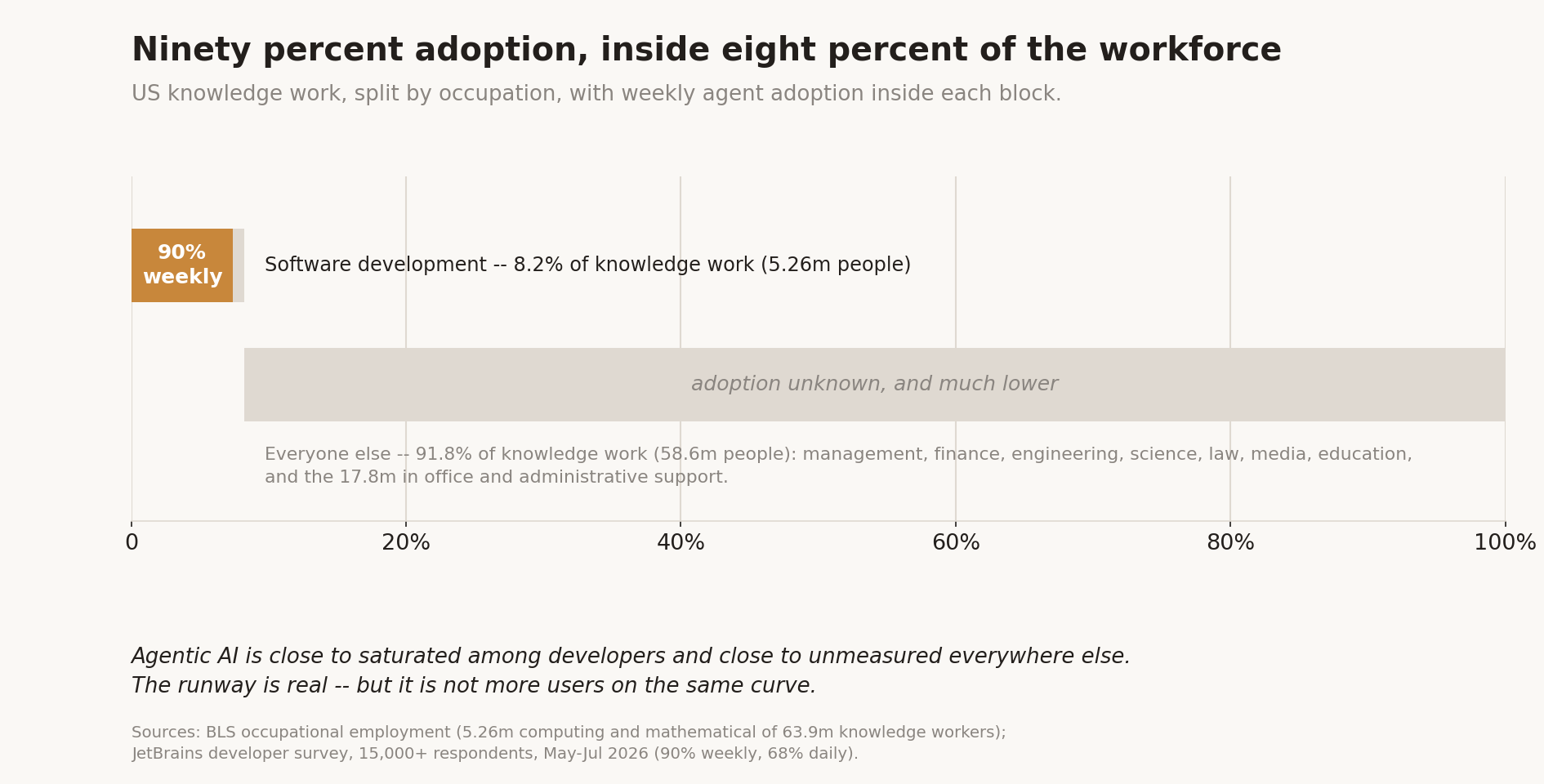
That is a different claim from "we are at one tenth of one percent." The runway is real, but it cannot be filled by adding more users to the same curve. It requires the technology to cross into professions where it has not yet demonstrably worked, and where, unlike code, there is no deterministic, verifiable function to tell you the output was wrong.
Part 5: The real dividing line is whether the work has a judge
That distinction, rather than the one about programmers, is the most useful idea in this article. Software did not go first because developers are clever, or because code is somehow special. It went first because code can be judged. It runs or it throws, the tests pass or they fail, the types check or they do not, and a machine can be allowed to try, fail and retry a hundred times because something other than a person is checking the answer. That is what makes long agentic runs economically sane rather than alarming.
It also suggests a third category that the debate keeps missing. Mathematics has proof. Chemistry and biology have assay and experiment. Engineering, materials and robotics have simulation and physical test. Each has a deterministic check of its own, and in each a wrong answer announces itself. If the binding constraint on agentic AI is the availability of a verifier rather than the profession it is pointed at, those are the fields it should reach next -- and they look nothing like the call-centre story, because the work is augmented rather than replaced, headcount tends to rise with capability rather than fall, and the token bill is trivial against the value of a result that would otherwise take a laboratory a year.
No instrument exists for any of that, and this piece is not going to pretend otherwise. There is no index of agentic adoption in materials science, and this section is reasoning rather than measurement. It is also the most interesting unmeasured question in the argument, and anyone sizing the runway off call-centre headcount is looking at the wrong end of it.
Part 6: The crossing has begun, and part of it is measurable
Two pieces of evidence, both from companies under no obligation to publish them.
Microsoft reports 30 million paid Microsoft 365 Copilot seats, overwhelmingly not developers, in an earnings release.
And in July, Anthropic published an analysis of 1.2 million sessions of Claude Cowork drawn from more than 600,000 organizations. Cowork is the agentic product pointed at everyone who is not a programmer, and the session mix looks like this:
| Use | Share of sessions |
|---|---|
| Business process and operations | 33.4% |
| Content creation and copywriting | 16.4% |
| Software development | 8.7% |
| DevOps and infrastructure | 7.0% |
| Research and intelligence | 6.4% |
| Data analysis and business intelligence | 5.8% |
Nine tenths of it is not software. The largest single category is business process work: the administrative middle of a company, the part with no verifier.
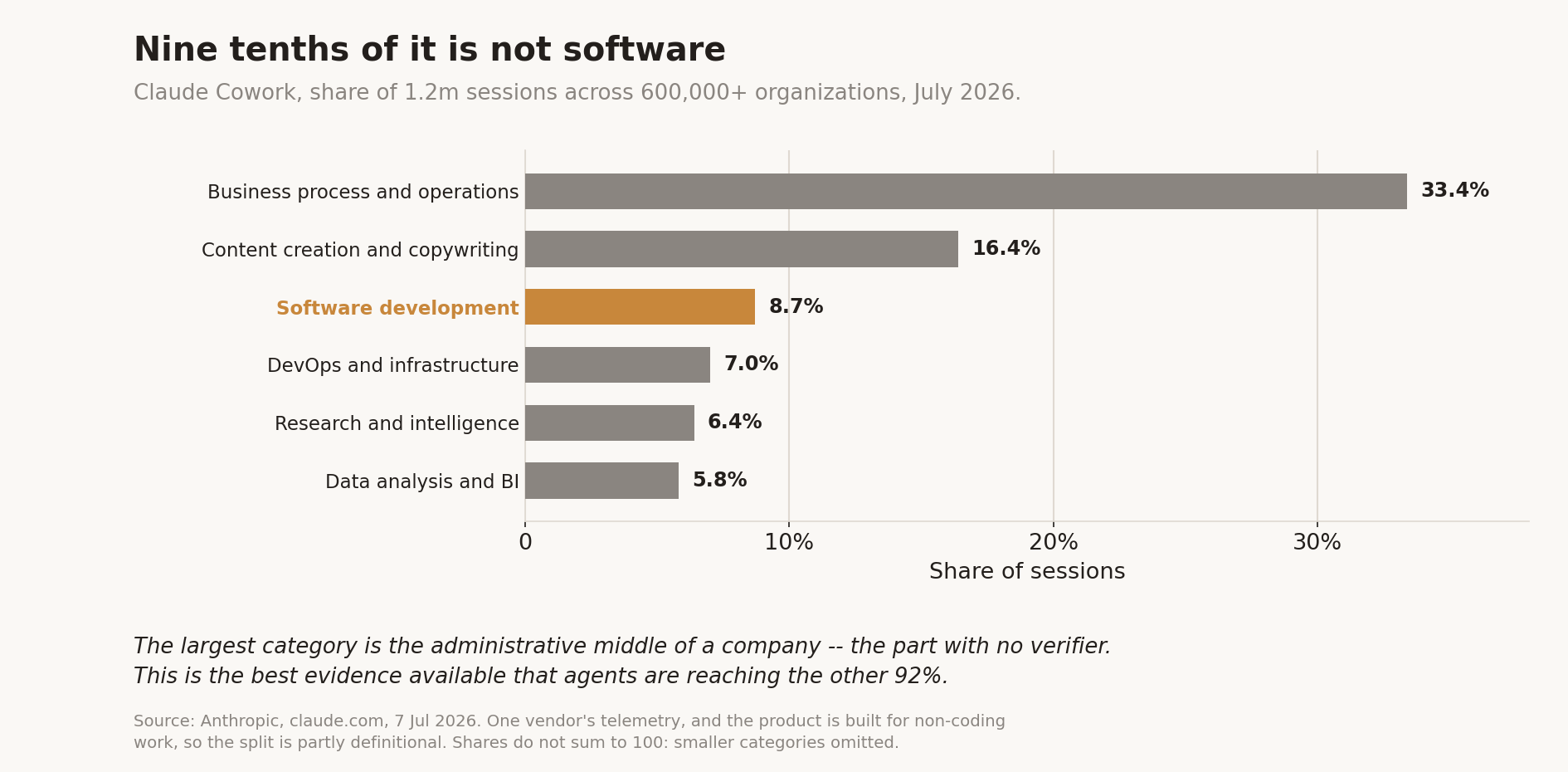
Three caveats apply, and they matter. Cowork was built for non-coding work, so finding non-coding work in it is partly definitional. It is one vendor's telemetry. And it describes what people do with the product rather than how many people have it: 600,000 organizations is a real number, but an organization can be three people.
It is still the best evidence available that the crossing is underway, and it is more than a press release -- a dated, sampled, methodologically caveated study of what the other 92 percent actually do when handed an agent. That is the number to watch, and it is why the next few quarters matter more than any podcast.
Part 7: What that is worth, roughly
The US Bureau of Labor Statistics puts 63.9 million Americans in knowledge and information work -- management, business and finance, computing, engineering, science, law, media, education, and the 17.8 million in office and administrative support. Their combined wage bill is $5.72 trillion a year.
Against that, OpenAI and Anthropic between them booked $18.3bn of revenue in the second quarter of 2026, or $73bn annualised. That is about 1.3 percent of the American knowledge-work wage bill, and because the wage bill is American while the revenue is global, the true share is lower still.
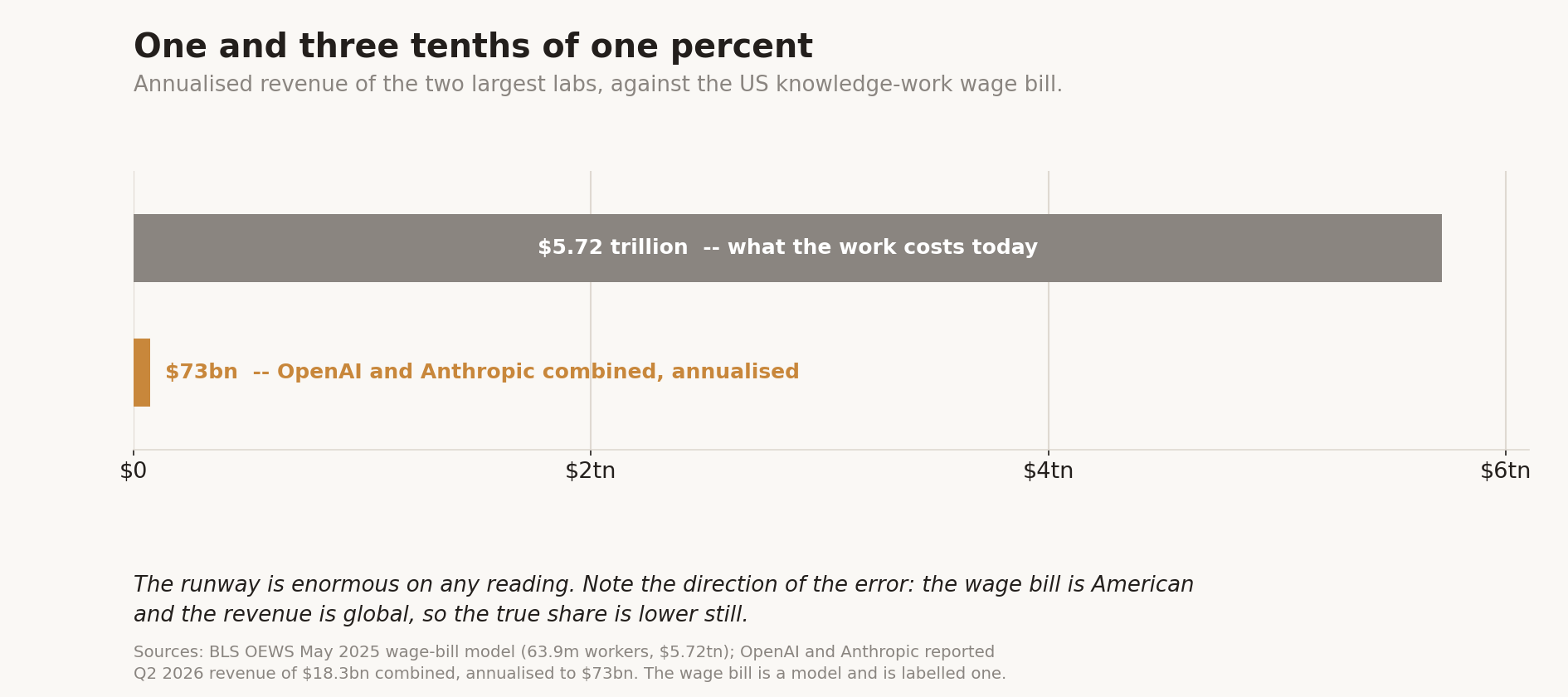
On even a conservative reading, the runway is large. If token spend ever reached five percent of compensation, the American market alone would be worth roughly $286bn a year, four times today's global revenue from the two largest labs. That five percent is an illustration rather than a forecast; nobody has measured what the number should be.
Part 8: Which leaves the question Part Two has to answer
The bull case survives this article intact, but it needs stating precisely: the runway is in depth rather than breadth, the breadth numbers cannot be used to size it, and the crossing will happen fastest where a machine, not a person, can mark the work.
Every one of those figures is a quantity -- users, seats, sessions, 63.9 million knowledge workers. None of them is a price. Quantities are the easier half of any demand question, because a quantity tells you how many people showed up, while a price tells you what they were willing to pay to stay.
If demand for intelligence really is insatiable, prices should be telling the same story these user counts do. They are not. In the year to August 2026 the cost of standing at the frontier doubled, while the cheapest way to buy the cheapest model fell to about four cents a million tokens. Two prices, one market, opposite directions.
That is the subject of Part Two of this piece, which follows shortly.